
Bartholomew County Criminal Docket Searches
Need a public Bartholomew County criminal docket? The main online tool is Indiana MyCase / Odyssey Public Access. It is free. No account is needed. Pick Case, Name, or Attorney. Select Bartholomew County, and trim a broad result by status or filing dates. A case search takes a case number, citation number, or cross-reference, one at a time. Name searches need at least a last name or business name. The optional sounds-like tool helps with tricky spellings. It will not work together with a wildcard.
- Open MyCase and select Bartholomew County.
- Enter the exact case number, or use a full name with added birth-date or file-date details.
- Open the matching Case Summary and confirm the court, status, file date, and case type.
- Read Events, Hearing Events, charges, bonds, dispositions, sentences, and document flags in date order.
- Ask the Clerk or court reporter for an official copy, transcript, or record not available online.
MyCase caps results at 1,000. A common last name in a Bartholomew County docket search usually calls for a tighter date range. Expect a CAPTCHA after you hit Search. Need a person instead of a screen? Call the Clerk at 812-379-1600. Or stop at the counter at 234 Washington Street in Columbus. You can also mail a request listing the cause number and a clear description of the document. Each court also answers direct calls: Circuit at 812-379-1605, Superior I at 812-379-1623, and Superior II at 812-379-1610.
Bartholomew Criminal Case Codes
Indiana's uniform numbering shows where a Bartholomew County criminal docket started. Bartholomew carries county code 03. The court IDs are 03C01 for Circuit, 03D01 for Superior I, and 03D02 for Superior II. After that come four digits for year and month. Then come two letters for case type and six sequence digits. A Level 6 felony might look like 03C01-YYMM-F6-000123. Rely on the number printed on your own notice, though. The Indiana uniform case-number rule spells out each segment of the format. Its official page holds the full breakdown.
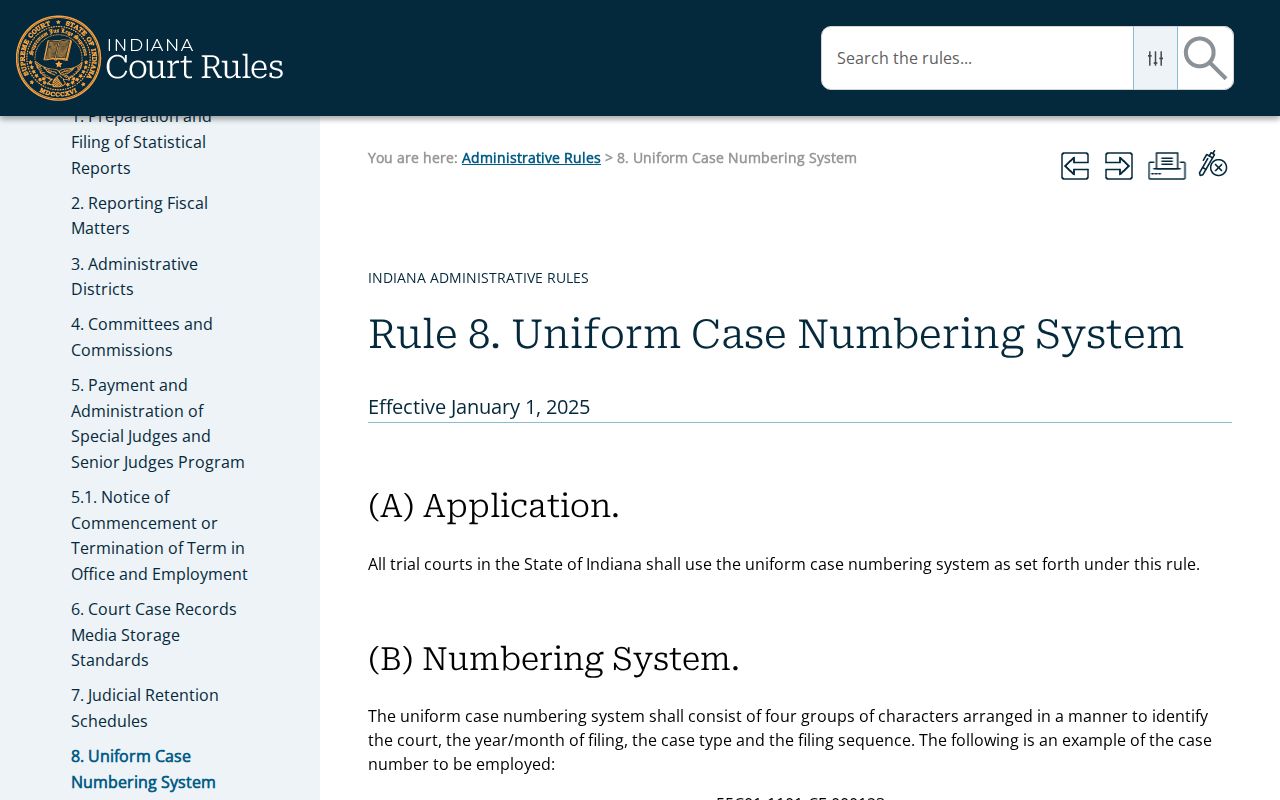
A transfer can change the court prefix while the sequence stays the same. Follow the full history rather than assuming the first court kept the case.
Criminal Dockets: What They Show
A Bartholomew County criminal docket summary pairs a header with a list of dated events. You need both. The header names the court, the file date, open or closed status, the case type, and any public flags. Events show what got filed, set, issued, or decided. A document name or page count alone does not guarantee an open image.
| Charge | Count, offense date, statute, description, and level; it remains an allegation until disposition. |
|---|---|
| Bond | Type, amount, status, and posted, released, forfeited, or refunded dates when recorded. |
| Hearing | Date, time, court, officer, result, settings, and cancellation reason. |
| Event | Filing or order date, label, comment, judge, and document metadata. |
| Outcome | Charge disposition, judgment, sentence, conditions, and financial terms where public. |
You may also see parties, attorneys, agency cross-references, and transactions on the docket. For current balances, contact Shari Lentz, Clerk of the Bartholomew Circuit Court, since figures online may lag.
Bartholomew Criminal Events in Plain Terms
Read docket labels as acts on a date, not conclusions. A filed information lists prosecution counts; it is not a judgment. A probable-cause finding clears an early threshold only, and a jury trial marked scheduled does not prove one happened.
- Initial hearing
- An early setting where the case and rights are addressed.
- Status of counsel
- A hearing about representation, not the charge merits.
- Change of plea
- A plea setting; read the later order and disposition.
- Disposition
- The recorded resolution of a count or case.
- CCS
- The Chronological Case Summary, Indiana's dated case history.
MyCase entries might include a no-contact motion, service, a clerk bond release, or electronic notice sent to Indiana State Police. Each row records what happened that day, so check nearby rows for context.
Criminal Case Stages on the Docket
A Bartholomew County criminal docket may not follow a straight line, but its core flow is clear. Filing → Arraignment → Pretrial → Plea or Trial → Disposition → Sentencing. Motions, service, counsel hearings, resets, and bond entries can fall between. A dismissed count and conviction on another count can share one case, so status alone is not enough.
Check Hearing Events on their own. Write down the court, date, time, judicial officer, result, and any cancellation reason. Did a setting get reset, or does it conflict with a notice? Call the assigned court. The county publishes no separate criminal calendar search. The case summary and the court phones are the channels that work. Local procedure shapes the event trail too. Under Bartholomew's rules, an agreed continuance starts with a conference call to the court reporter. That call lets the parties seek an agreed date. If the reporter cannot be reached, the court may set a date that binds the parties. A party may also refuse to cooperate. A continuance request alone does not erase the old setting. Read the later order or hearing result before treating any date as changed. Specialty-program references deserve the same care. Superior I oversees Veterans Treatment Court, and Superior II supervises the Drug and Alcohol program. Court Services also publishes a Drug Recovery Court referral form. A referral does not prove admission. Nor does a program fee or a program-related docket event prove completion or a sentence result. Treatment details may stay confidential. That can hold even when the public criminal case shows an order or a general program event.
Bartholomew Criminal Court Assignments
Criminal work is divided by the official county courts page and the local rules. That split explains why a case can sit in Superior Court while the Circuit Clerk keeps the county court record.
| Court | Criminal work | Code |
|---|---|---|
| Circuit | Adult felony work; rotates other felonies and murder with Superior I. | 03C01 |
| Superior I | Level 1 through 6 felonies, some misdemeanors, and felony rotation. | 03D01 |
| Superior II | All misdemeanors, infractions, driving-related assigned felonies, and many Level 6 cases. | 03D02 |
Domestic-violence Level 6 matters rotate among all three courts. The highest level controls assignment, co-defendants stay together, and conflicts move cases among the courts under a set local route.
Bartholomew County Criminal Docket Courts
Don't pick a Bartholomew County court by the name of the charge. Start with the case code. Circuit and Superior I split much of the felony docket. Superior II handles most misdemeanors, infractions, and driving matters. Written permission is required for any manual change. A related case can also land behind a matter already pending on the criminal docket.
The Clerk serves all three courts as the record and payment office. For transcripts and audio, go to the court reporter instead. That split is set out in the local rules. Current and certified papers can be requested at the counter or by mail. The Clerk's form can email a qualifying electronic document tied to a cause number. It promises a response within seven business days.
Older criminal files travel a different road. Bartholomew County Archives keeps early Circuit, Common Pleas, State Records, and prisoner collections. You can search categories online. You can also reach Archives by phone or mail. The fees are modest: a $1 base, ten cents per copy, plus mailing. Pay by check or money order, since Archives does not email documents. Turn there when a case falls before the Odyssey docket range. A current transcript still goes to the reporter.
Missing Bartholomew Criminal Dockets
A blank result is not proof that no Bartholomew County case exists. Check the case number, county, spelling, status, dates, and Odyssey coverage again, because juvenile, sealed, expunged, mental-health, and excluded records can all be missing, and older docket books may sit with County Archives.
If the online trail ends: call the assigned court for a date or status, the Clerk for a file or balance, the reporter for a transcript, and Archives at 812-379-1503 for historic material. A courthouse public terminal may exist, but confirm current details before visiting.
Match the request to the office that holds the record. The Clerk's electronic-document form needs a cause number, your contact details, and a clear description, and it works only when a document can be emailed. A certified judgment or order must go through the Clerk's certification process. Archives handles historic searches online, by phone, or by mail. It will not email documents. Asking the right office first saves a round trip.
Some fines and fees can be paid online. Restitution cannot. MyCase lists transactions. Its own help text warns the figures may lag, and a local rule can add a $25 late fee when its nonpayment terms kick in. Before paying, ask the Clerk for the live amount, the accepted method, and your cause number. The Third Street drop box covers defined categories only, so don't assume it takes every criminal payment.
Access Rules for Criminal Dockets
Indiana starts from a presumption of access, with firm edges. A case is public unless an Access Rule, statute, seal, privilege, or court order excludes the record. The general access rule sets out that baseline.
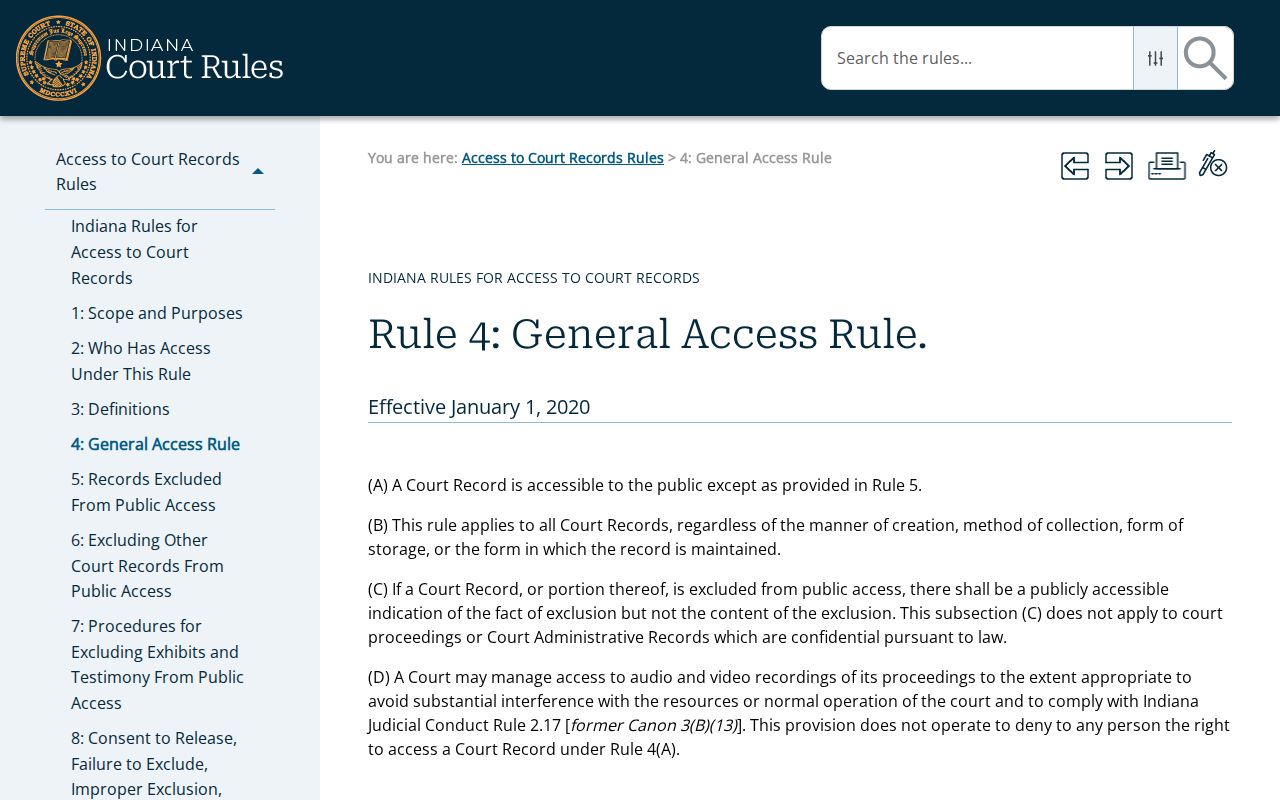
Open access does not put every filing online. The excluded-record rule covers sealed, mental-health, statutory confidential, investigative, and other protected material.
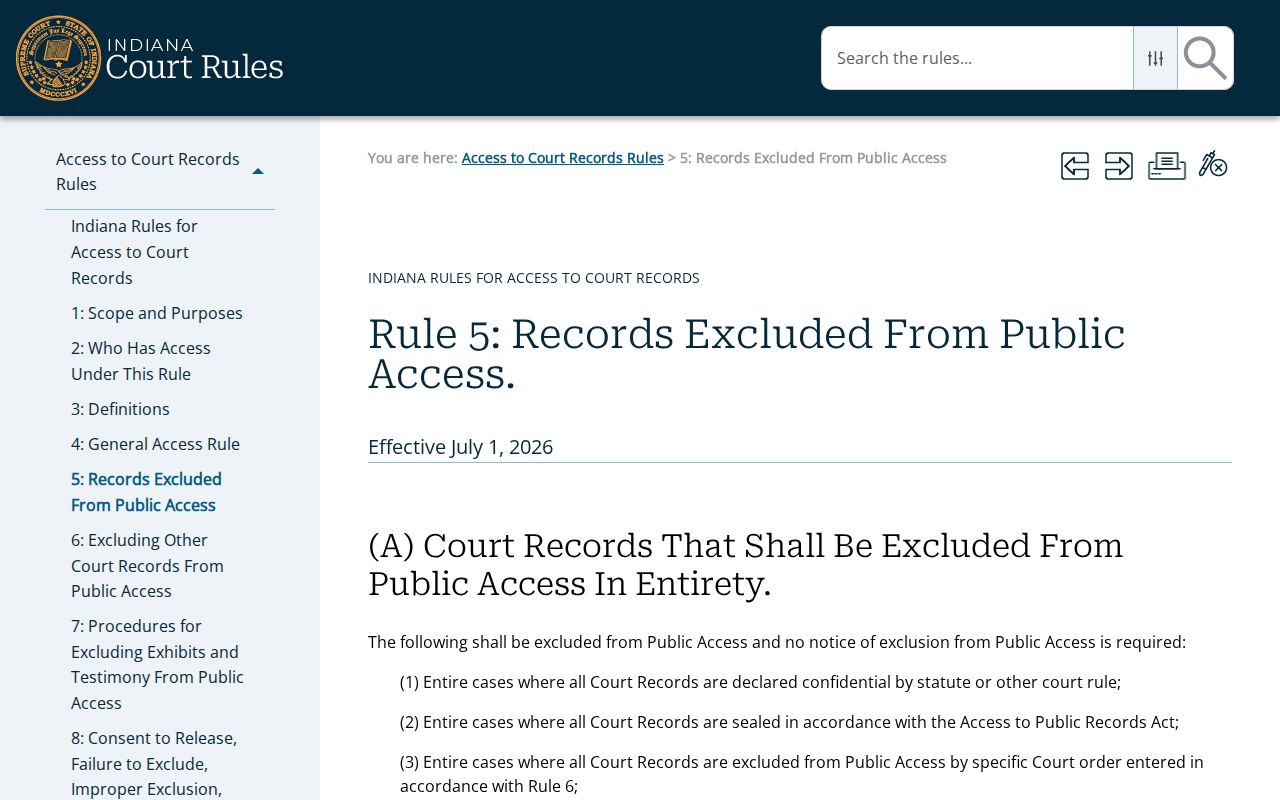
That rule explains the gaps. A Bartholomew County docket search can omit a whole case or hide one filing while the other court events stay in view.
Key Indiana rules:
Access Rule 1 states the open presumption.
Access Rule 5 lists exclusions.
Access Rule 9 provides a strict verified-request process.
Bartholomew Expungement and Docket Access
Once an expungement is granted, the criminal record can vanish from MyCase. Pending or denied matters may still show. The Indiana expungement statutes control that process. A missing result proves nothing either way, so never read absence as an expungement or an outcome.
The statute governs, and the Clerk or court answers case-specific access questions.
Indiana's APRA builds a broad public-record framework, but court records follow the specialized Access Rules. An APRA letter will not open a sealed file. Rule 9 requires a verified request. It also demands a public-interest and harm review, notice, and sometimes a court order.